The Table

A devastated industrial site, a plain grey asphalt space covered in millions of small cement fragments, and only a thin strip of spring grass stretching parallel to the two men sitting behind a simple-cut wooden table. Amid this chaos, it appears that these two men with their table offer the only steady presence, the only sight of a human civilizational footprint in this wrecked landscape, some form that is stable and at least partially known to our routine life imagery. The table barely reaches their knees, while it seems to miraculously keep standing under the burden of numerous unidentifiable objects, almost as if it were a part of some hardly recognizable “whole” that still maintains this interaction.
Both men are wearing a dark-green MultiCam. Both men are white, and there appears to be no interpreter in sight. In fact, both men likely had their high-school algebra books authored by the same person, watched movies interwoven with similar narratives as adolescents, lived in architecturally similar urban designs, and probably even uphold similar traditions on New Year’s Eve. Yet, the table’s sides are opposing each other in every other way the professional conduct of these men differs.
A closer look at the remains streaming behind reveals an image of a factory workshop. Severely penetrated by objects of sizes ranging from a couple of decimeters to entire corner chunks, with the latter offering a glance inside the higher floors’ void through a missing panelled wall. What’s now being discussed at the table will decide the fates of several hundred civilians sheltering somewhere in the net of maintenance labyrinths beneath the ruptured steelworks.
Or rather, it may appear as if it will decide. As words of reason and the remnants of the Ukrainian military power in Mariupol would be able to somehow alter an already settled course by the Russian higher command. As the talks over the Ukrainian offer of a UN “green corridor” for civilians, which should escort the sheltered out of the deadly Russian claws on the Azovstal steel plant, could alter the latter’s objectives. The claws, made of the entire hierarchy of the Russian military command, of which the other MultiCam man is a part. In a matter of blossoming spring weeks, carpet air campaigns turned the prospering Ukrainian marine metropolis into steaming piles of panel ruins blending the remnants of civilian corpses, like Pierre Hermé’s cake layers, nuts in chocolate depths. The civilian death count still cannot be narrowed down to even tens of thousands, four years since that May.
It may appear that the negotiating side, represented by a bold head of the Russian general, upholds the law of war in its pursuit of the absurd invasion with obscure aims. However, the gleaming background ruin, light-grey debris cover on the photograph, and the bled dry ghost of the once buzzing city that escaped the frame, object with the silence of tens of thousands buried under their own home.
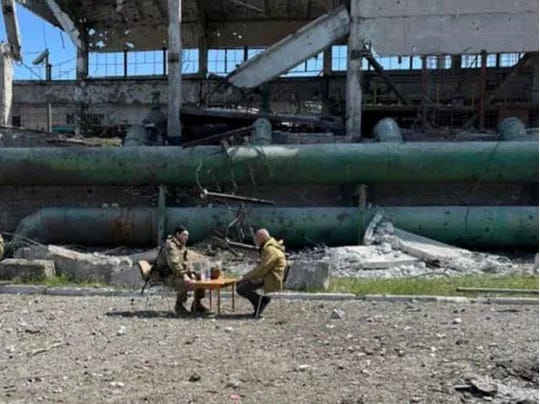
Ukrainian and Russian sides during evacuation negotiations at the in the neutral zone between the “Kommunalnik” and the “Azovstal” metallurgical facilities, May 2022. Photograph by Brig. Gen. Denys Prokopenko, commander of the Azov Brigade.
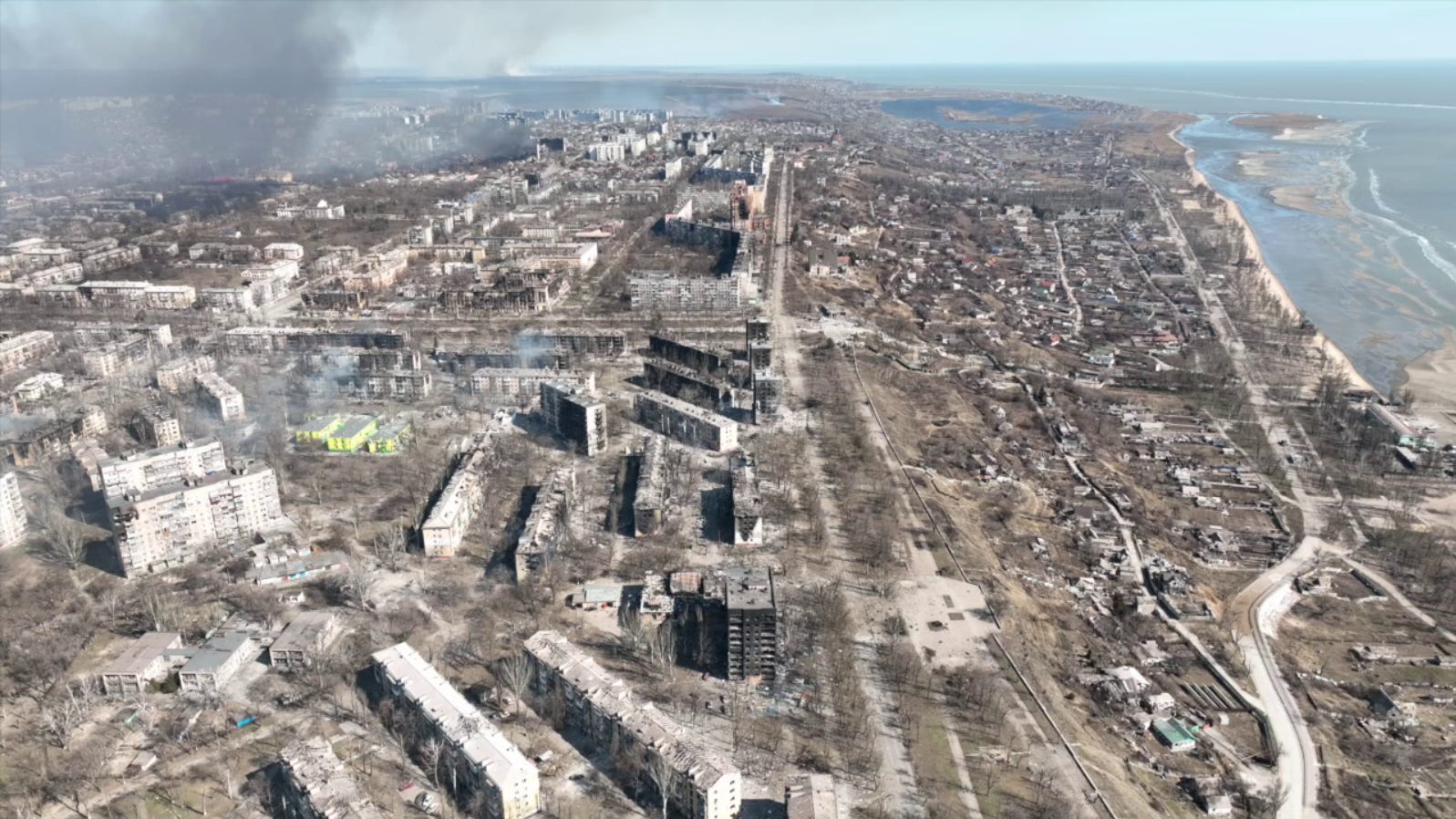
Aerial view of Mariupol during the Russian siege, March 23, 2022. Photograph by the 1st Corps NGU “Azov”.